Rosie was a Shih Tzu, and her sister Daisy still is — eleven now, slower than she was, and looking for Rosie in the mornings in a way that breaks my heart in a small new place each time. We lost Rosie in the late winter. Fourteen years is a long, good life for a dog, and I knew that, and it did not help as much as people think it should.
I am sixty-two. I have grandchildren. I have buried more than one creature I loved and I thought I knew the shape of this kind of grief. What I did not expect was the specific panic about the photos. The sense that if I could not see her face clearly, I would slowly lose the exact way it looked, and that the one good photo was a thin thread holding the whole memory up.
My granddaughter and the laptop
My granddaughter Sophie is twenty-one and studies graphic design, and she is the kind of young woman who notices when her grandmother has gone quiet. She came over on a Sunday, the way she does, and she found me with the porch photo open on my phone, not doing anything, just looking at it.
"Gran," she said, "have you ever thought about getting her painted?"
I told her the truth, which was that I had thought about it and dismissed it, because I only had the one good photo and it wasn't even sharp, and surely you needed a proper photograph for a proper portrait. Surely one soft picture wasn't enough.
Sophie pulled her laptop out of her bag. "Let's just see," she said. "There's a place a girl in my program used — Fido & Frame. You can see the whole thing for free before you do anything. You don't even have to sign up. If it's not right, we just close the laptop."
What worked from one imperfect photo
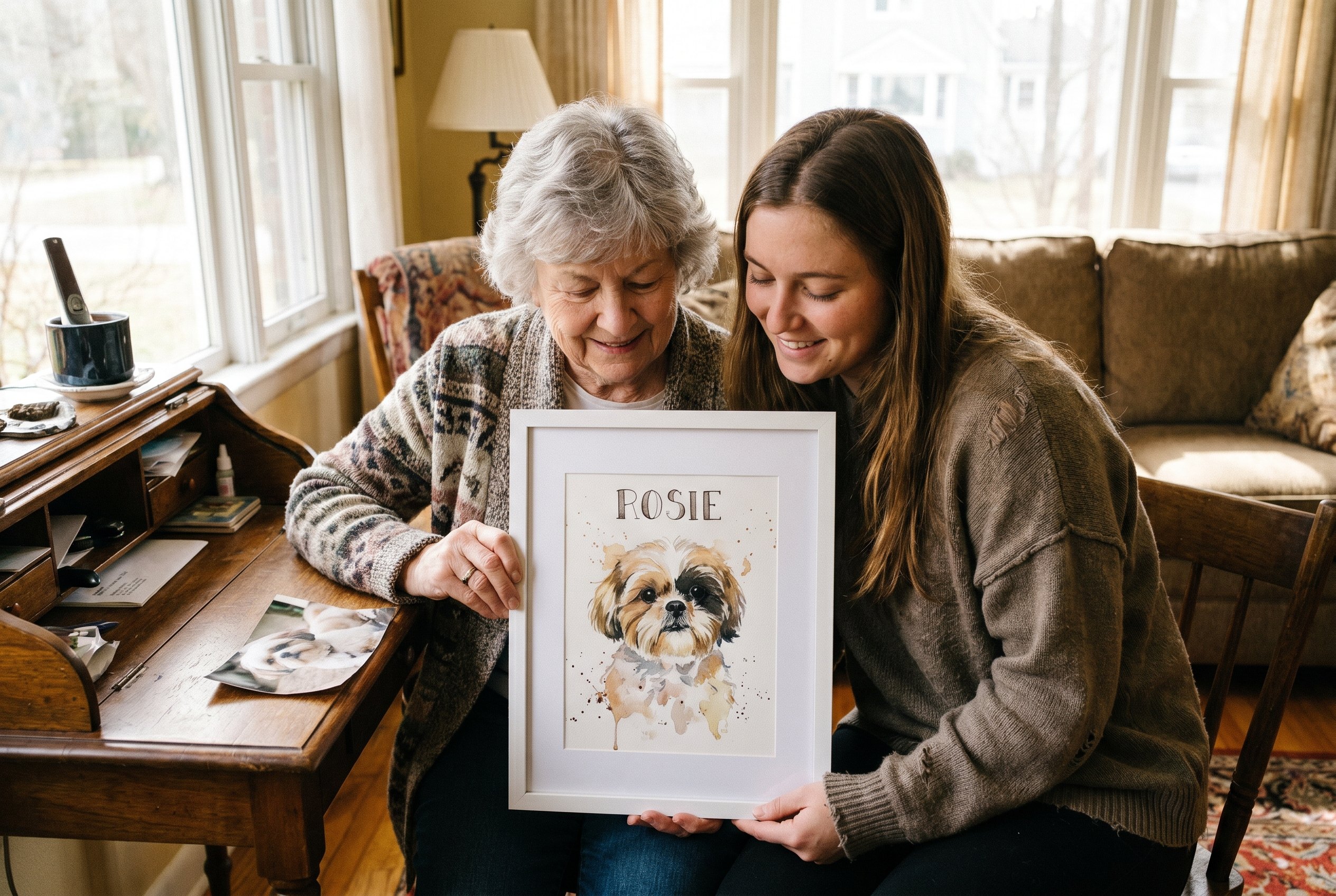
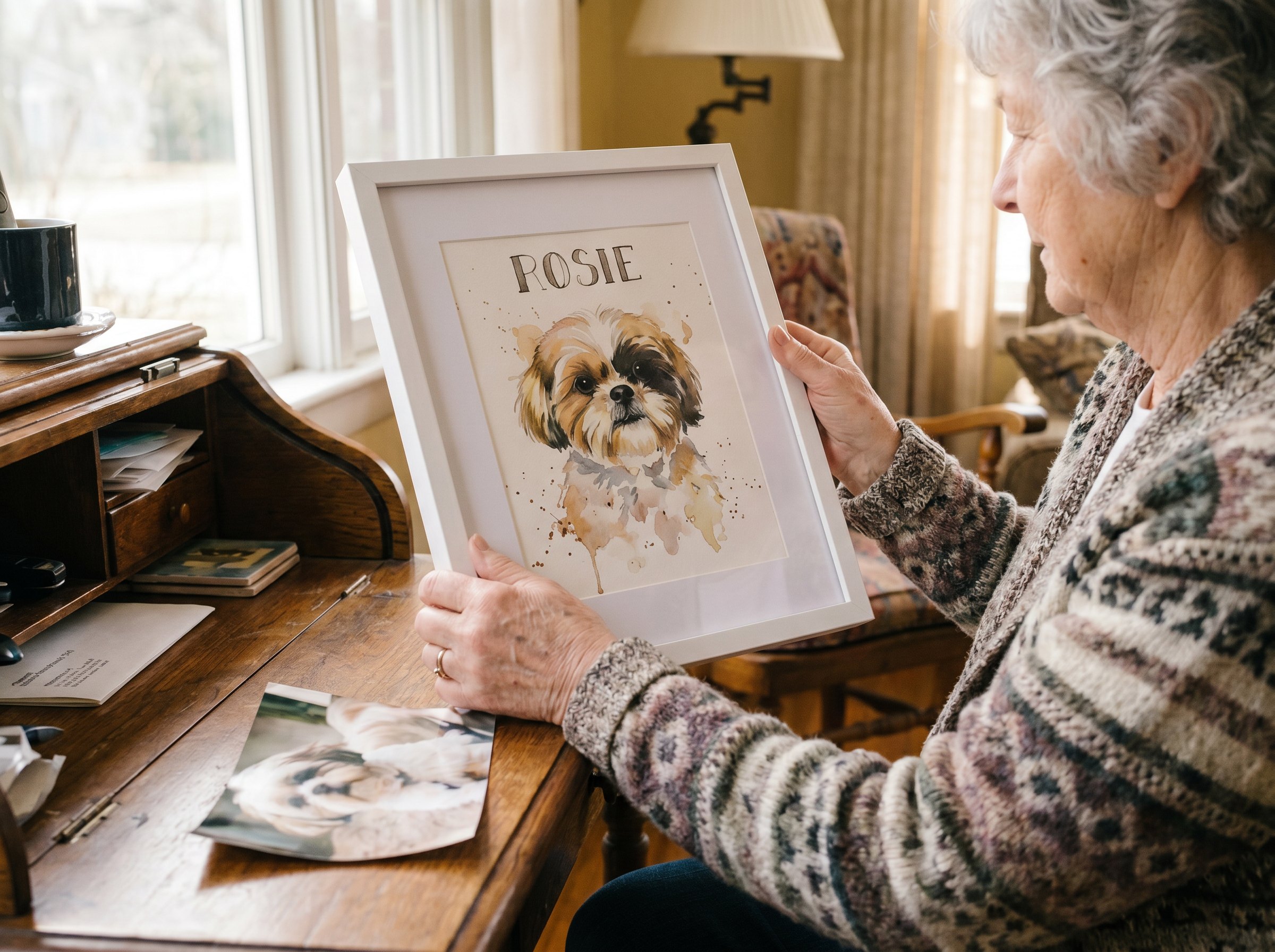
She uploaded the porch photo — the only one — and asked for watercolor. And in a few moments, on Sophie's screen, there was a free preview. Rosie.
Here is the thing about the soft focus I had been so afraid of: in watercolor, the softness stopped being a flaw and became the medium. The slight blur of the photo had turned into the gentle edges of paint. Her eyes were clear. The tan over her left eye was right. The underbite she'd had her whole life, the one that made her look perpetually unimpressed, was there. It was not a sharp photograph made into a painting. It was Rosie, the way I held her in my mind, made visible.
I put my hand over my mouth. Sophie put her arm around me. We sat like that for a while.
What I ordered, and what I paid
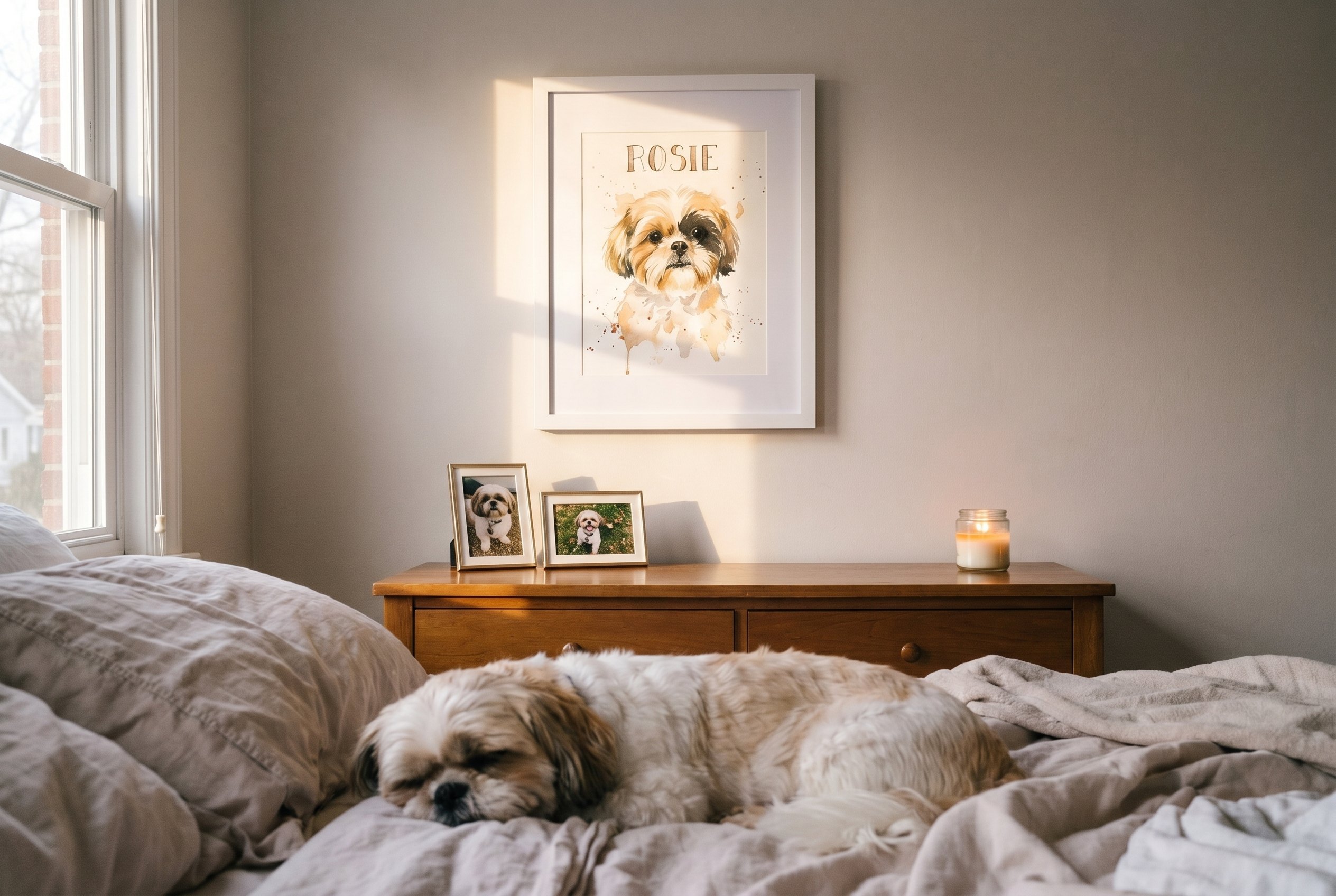
I chose the Art Print rather than a canvas — the medium 24×16. It's lighter, it ships rolled on museum paper, and it felt right for where I wanted it: not over a fireplace for company to admire, but on the wall of my own bedroom, where Rosie used to sleep, where I would see her first thing.
The list price was $119.
When the preview loaded, a welcome discount had already been applied — $30 off my first order. There was no clock, no pressure. Final price: $89, with free shipping. It came in about a week, and there's a 30-day guarantee, though I knew the moment I saw the preview that I wouldn't need it.
Where she lives now
Rosie hangs on the bedroom wall, in a simple frame, where the morning light reaches her. Daisy has taken to sleeping beneath her, which I do not think is a coincidence, though I cannot prove it and would not want to.
I think about the months I almost let the fear win — the certainty that one soft photo was not enough, that I had missed my chance to have her properly. I had not missed it. The one good photo was enough. It is almost always enough.
If you are sitting where I was sitting, with a phone full of blurs and one picture you are afraid to hope on — you can simply look. See what comes back, before you owe anyone anything. That was the whole gift of it for me. I got to see her again before I had to be brave.