Cooper was a yellow Labrador. We got him as a puppy when Emily was eight. He was the family dog the way some dogs become family dogs — entirely. He went on every road trip. He waited at the bottom of the stairs every morning. He learned, eventually, to recognize the sound of my husband's truck from three blocks away.
He was twelve when we lost him. Cancer, fast — about ten weeks from diagnosis. I will spare you the details because I do not want to make anyone reading this cry harder than they need to. The end was peaceful. He was on a folded quilt in the den, which had always been his favorite room, and Emily had flown home, and we were all there, and he went the way you would want a dog you loved to go.
And then he was gone, and the den was the worst room in the house, and I could not bring myself to fold up the quilt.
What I had been afraid of
I had been afraid, in the weeks after Cooper, of seeing him.
This is going to sound strange, and I am only just learning how to explain it. I had this idea that any photo of him, any reminder, any sudden encounter with his face — would crack something open in me that I would not be able to close again. So I avoided them. I closed the photo album. I scrolled past pictures of him on my phone. I left his collar where it was on the hook because I could not yet pick it up, but I did not look at it.
What I did not know was that this kind of avoidance is not the same as protection. It was just a different kind of pain. A pain of absence on top of a pain of absence.
Emily, who is thirty-two and has always been smarter about emotional things than I am, must have known this.
The package
On a Thursday, three weeks and two days after we lost him, a flat package arrived on the porch. It was canvas-shaped — long, narrow, oddly shaped for a delivery. I brought it inside. There was no return address I recognized.
I called Emily, who was at work in Chicago.
'Mom,' she said, 'open it. I'll stay on the phone.'
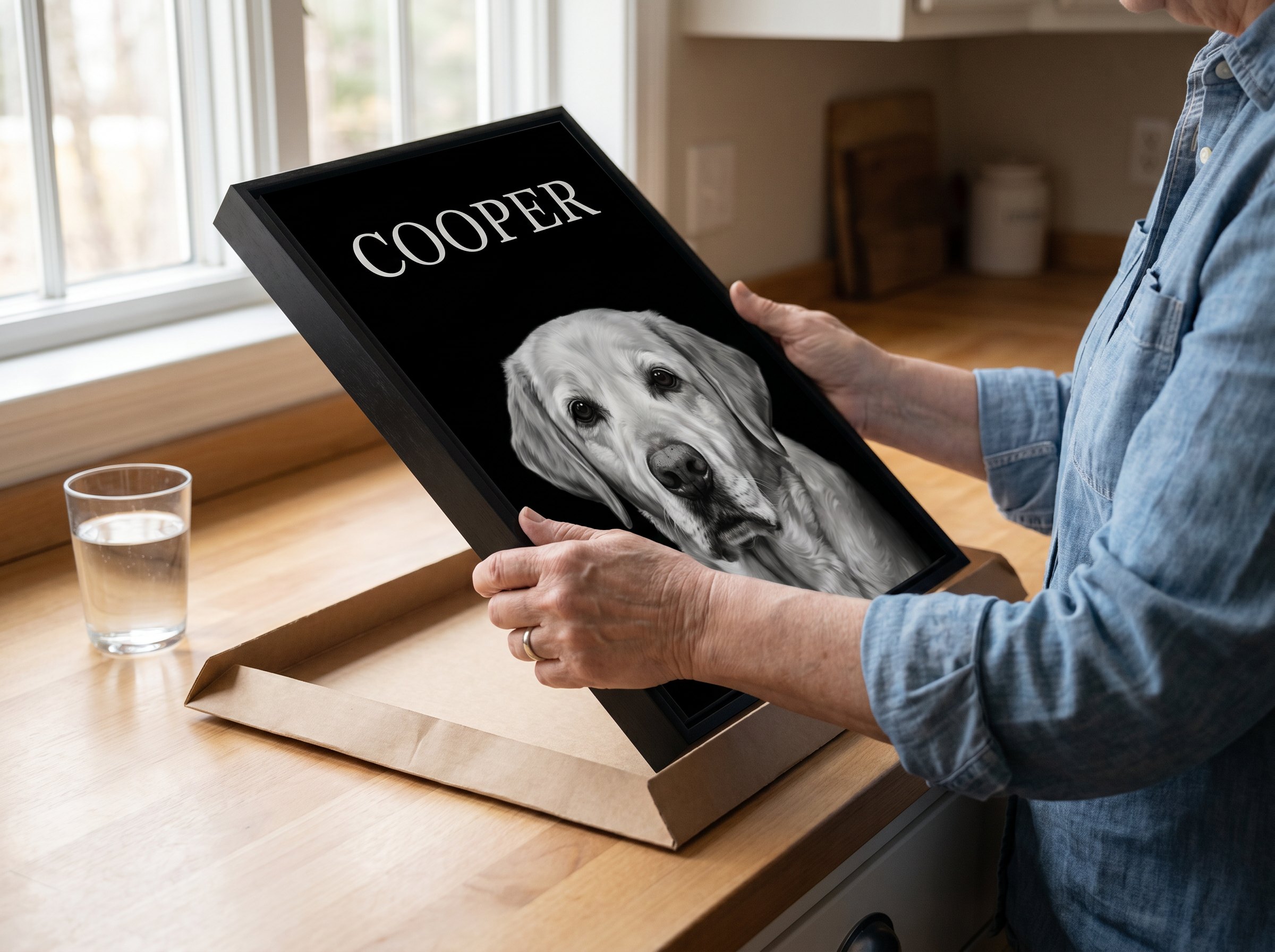
I opened it on the kitchen counter. I cut the kraft paper tape. I lifted the flap.
It was Cooper.
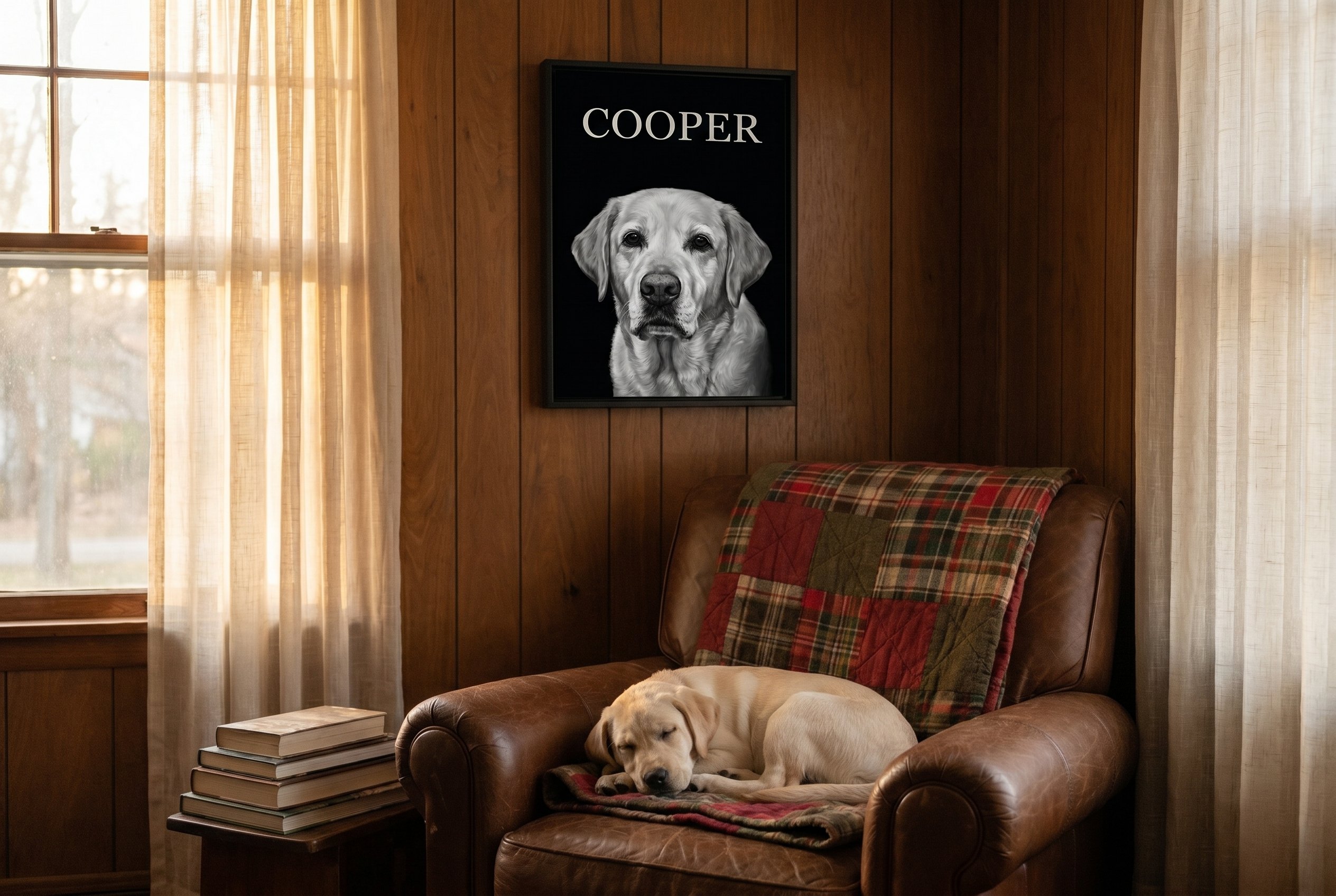
Black and white, on a deep black background. Sixteen by twenty-four inches. Vertical. He was in profile, the way he sat in the den on the quilt, his head turned slightly toward the camera the way it always was when he was waiting to see if you were going to ask him for something.
The yellow of his coat was the right yellow. The graying at his muzzle — which had only just started, in the last year — was there. The slight droop of his lower lip on the right side, which had been a Cooper-specific feature for as long as I had known him, was there. His eyes were tired and patient, the way they had been at the end and the way they had been all his life.
It was him. Not a generic Labrador. Cooper.
I put the phone down. I did not pick it back up for a while.
What I felt that I had not expected to feel
I want to be careful here, because I know there is no universal experience of grief and I do not want to prescribe anything for anyone.
But here is what happened to me.
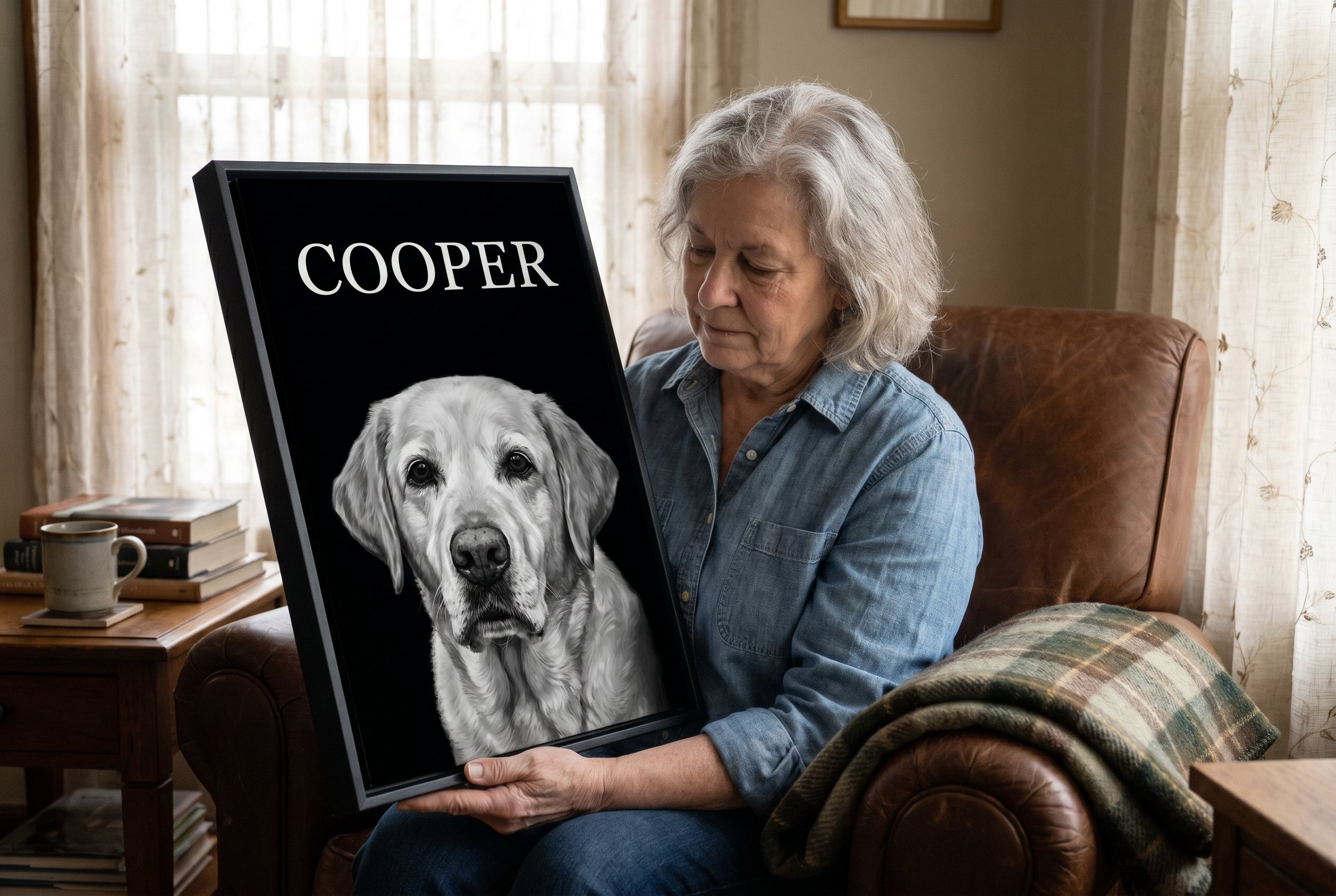
I cried, for a long time, harder than I had cried since the actual day. Not in a bad way. The crying was a different kind. It was crying that had a person in it, instead of just an absence. I had been grieving an empty room. Now I was grieving Cooper, specifically, and somehow that was easier to carry.
I sat with the canvas on the table for an hour. I touched his face on it. (You're not supposed to do that with archival prints. I did anyway.)
And I noticed, for the first time in three weeks, that I was glad. Not happy. I was not happy and I was not going to be happy for a while yet. But I was glad. Glad for him. Glad for what he had been. Glad to look at his face again.
Avoidance had been keeping me away from the gladness. The portrait gave it back to me.
Where Emily found it
When I called her back, hours later, I asked Emily where she had ordered it.
She told me about a small American studio called Fido & Frame. She had ordered it the week after we lost him. She had uploaded a photo of Cooper that she'd taken last summer at the lake — one I'd forgotten she had — and she had asked for the black-and-white style, and she had used the free preview to make sure the eyes were right before she paid.
'The eyes are what matter, Mom,' she said. 'They were going to make him look generic. I asked them to make the eyes more like his. They sent a new preview. Then I paid.'
She told me that the studio's team reviews every portrait, that you can request changes through a real artist, and that she had felt — and these are her words — 'like an actual person was making sure my dad's dog looked right.'
She told me she had used a $30 first-customer discount they offered, which had made her feel a little less guilty about the cost. She mentioned the welcome offer was, last she checked, still running for new customers, with no countdown timer pressure — just a quiet, fair limited-time offer.
On the question of whether to order one if you've lost your pet
If you are reading this and you have recently lost a pet, I want to be careful about telling you what to do. Grief is its own animal and everyone walks with it differently.
But I will say this. I had been afraid to look at Cooper. I had thought looking at him would hurt more. It hurt differently — less, in fact, in a strange way that I do not fully understand yet. The portrait did not bring him back. The portrait did, however, let me have him back in the only way I now can: as a presence, as a face on a wall, as a quiet companion in the room where his quilt used to be.
If you are not yet ready, you are not yet ready. Trust that. There is no timeline.
If you are wondering whether you are ready, you might be. Only you will know.
And if you are years past your loss, and you have always meant to commission something but have not — please consider it. The dogs and cats we have loved deserve a place on our walls. Their faces deserve to keep visiting us.
Where Cooper hangs now
The canvas hangs in the den. Above the chair where I read in the evenings. The empty quilt is gone, finally — washed and folded and put in a closet, where I can find it if I need to but where it does not haunt me daily.
Cooper looks down at the room where he loved us, and where we loved him.
I look up at him most evenings. Some nights I am grateful. Some nights I cry a little. All nights, he is here.
Tom — my husband — picked up a young Labrador from a rescue last week. Riley. He is loud and clumsy and has chewed the leg of one chair already. He sleeps on the quilt now.
Cooper, in black and white, watches from the wall.
It is the right way for things to be.